
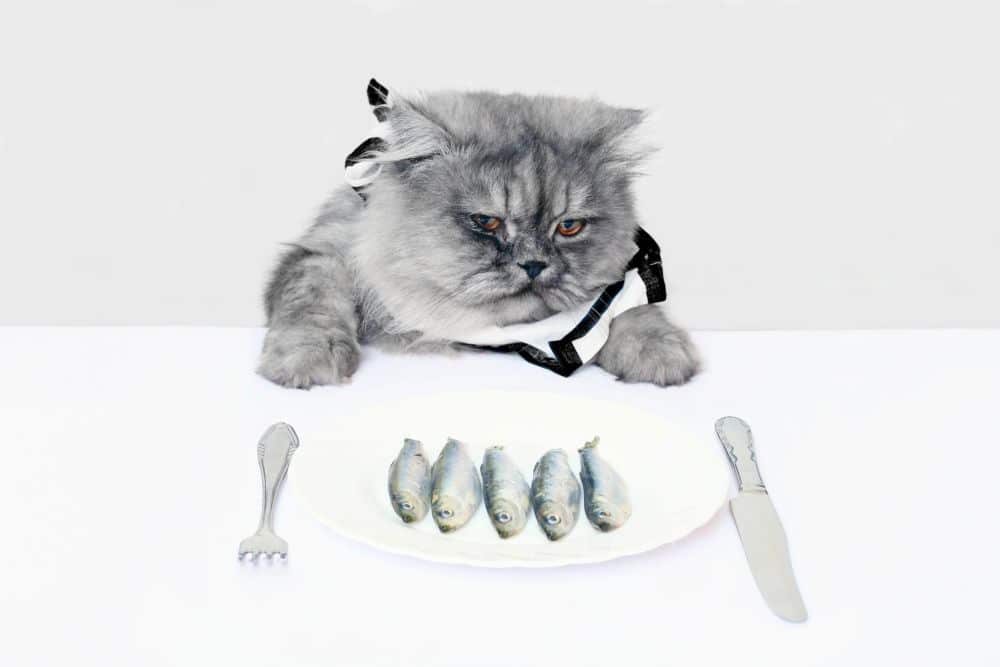
The best fish based cat food is commercial cat food that is specifically formulated for cats and contains Thiamine, which is added to correct the imbalance that too much raw fish for cats can cause. Too much raw fish in the diet of a cat can result in a Thiamine (Vitamin B1) deficiency.
Cats can still enjoy their fishy dinners because canned cat food is specifically formulated for to contain other vitamins and minerals for good health.
Canned cat food that is fish based, can be smelly and that remark often pops up in comments from cat owners. Kitty does not mind the smell even if it can be a bit offensive to us mortals.

Table Of Contents
Key Vitamins and Minerals in Commercial Fish Based Cat food
Cats are obligate carnivores, which means their diets must be primarily composed of meat, but they also need specific nutrients that might not be adequately supplied by fish alone.
In this article I have outlined cat food that is fish based and included all the ingredients in the fish based cat food shown. I have also separately listed (below) the vitamins and minerals that are frequently added to fish based cat food.
You can scan through the ingredients, to check if the fish based cat food you choose, meets your expectations regarding ingredients.
Some key vitamins and minerals that should be included in a balanced fish based cat food are noted below:
- Taurine – An essential amino acid that cats cannot synthesize in sufficient quantities. It is vital for heart health, vision, and reproduction. Fish is naturally high in taurine

 , but levels can decrease during processing, so supplementation may be necessary.
- Vitamin A – Cats require a dietary source of vitamin A, which is important for vision, skin, and coat health. Unlike dogs and humans, cats cannot convert beta-carotene from plant sources into vitamin A, so it must come from an animal source.
- Vitamin D – This vitamin is crucial for regulating the balance of calcium and phosphorus and maintaining healthy bones. Cats cannot synthesize enough vitamin D through sun exposure, so it must be provided in their diet. Fish, especially salmon and other oily fish, are good sources of vitamin D, but levels should be monitored to prevent deficiency or toxicity.
- Vitamin E – An antioxidant that helps prevent oxidative damage. It is also important for immune function and skin health. Fish-based diets can be high in polyunsaturated fatty acids, which increase the need for vitamin E to prevent oxidative damage.
- B Vitamins – Including thiamine (B1), riboflavin (B2), niacin (B3), pantothenic acid (B5), pyridoxine (B6), biotin (B7), folate (B9), and cobalamin (B12). These vitamins are involved in energy metabolism and are essential for a healthy nervous system and skin.
- Calcium and Phosphorus – These minerals are important for strong bones and teeth. The ratio of calcium to phosphorus in the diet is crucial; too much or too little of either can cause health problems. Fish bones can be a source of calcium, but the levels must be carefully balanced with phosphorus.
- Magnesium – This mineral works in conjunction with calcium and phosphorus and is important for many bodily functions, including nerve impulse transmission and muscle contraction.
- Potassium – Necessary for proper function of enzymes, muscles, and nerves.
- Iron – Essential for the formation of haemoglobin, which carries oxygen in the blood.
- Zinc – Important for skin health, immune function, and wound healing.
- Copper – Plays a role in the formation of connective tissue, iron absorption, and brain development.
- Selenium – Works as an antioxidant, protecting cells from damage.
Fish based cat foods should be carefully formulated to avoid deficiencies or excesses of these nutrients. For example, fish can contain high levels of heavy metals, such as mercury, which can be toxic in large amounts, so it is important to use fish that are lower in mercury for cat food.
Some fish can contain an enzyme called thiaminase, which breaks down thiamine (vitamin B1), leading to potential deficiencies. It is important to either use thiaminase-free fish or to ensure proper supplementation of thiamine.

Fish Based Cat Food
| 1. Fancy Feast Seafood Feast Grilled – Wet Food |
| 2. Instinct Grain Free Salmon Recipe – Wet Food |
| 3. Rachael Ray Wet Cat Food – Ocean Lovers Pack – Wet Food |
| 4. I And Love And You – Oh My Cod Fish Based Cat Food – Wet Food |
| 5. WholeHearted Mouthwatering Morsels Variety Pack – Wet Food |